
Summary
Choppy markets can be one of the most difficult environments for traders. Without clear momentum, forcing trades often leads to emotional decisions, poor entries, and unnecessary risk. In this article we break down the psychology of trading uncertain markets, examine recent setups in Robinhood (HOOD) options and S&P futures, and explain why patience and capital preservation are often the most profitable strategies during volatile conditions.
Market Watch
Economic Data

📚 Deep Dive 📚
The Journey & Psychology of Trading in Choppy Markets
One of the biggest psychological traps traders fall into during uncertain markets is the need to always be involved.
Many traders feel pressure to constantly place trades simply because the market is open. But when the market lacks direction, forcing trades usually leads to frustration and unnecessary losses.
Choppy markets create three common problems:
- Emotional trading
- Poor entries with no momentum
- Unnecessary risk exposure
Professional traders understand that protecting capital is just as important as generating profits.
Patience is not inactivity. It is discipline.
Case Study: The HOOD Options Setup
A great example of this happened with Robinhood Markets (HOOD).
Yesterday we alerted clients in the watchlist and charts channel about elevated call option activity in the March 20 $85 strike calls. The contracts were seeing notable volume as the stock pushed higher following Robinhood’s new product presentation.
Going into the morning session, the options were already in the money during premarket trading, which immediately made the setup interesting.
However, instead of rushing into the trade, we continued monitoring the price action and the option chain as the market opened.
The key moment came around the 10 AM candle.
While tracking the option contract pricing from the initial volume spike screenshot, the calls briefly surged as HOOD pushed higher early in the session.
At best, the move would have produced roughly +38% profit before a sharp reversal hit the stock.
That reversal was amplified by an implied volatility collapse following the overnight excitement from the Robinhood product announcement. As the event risk faded, the options quickly lost value.
Under ideal conditions we typically aim for +40% profit targets on these types of trades.
In this case, even if we had entered aggressively, the market likely would not have given us enough time to exit cleanly before the reversal accelerated.
By choosing to observe the setup instead of forcing the trade, we avoided a potentially stressful and volatile situation for our clients.
Sometimes the most profitable decision is the one that protects capital.
Case Study: S&P Futures and False Breakdowns
We saw another example of this environment in S&P 500 E-mini Futures (ES).
During the session, price attempted to break down below a rising support structure — a move that normally might trigger a short trade for momentum traders.
However, the broader structure suggested the market was still operating inside a larger range.
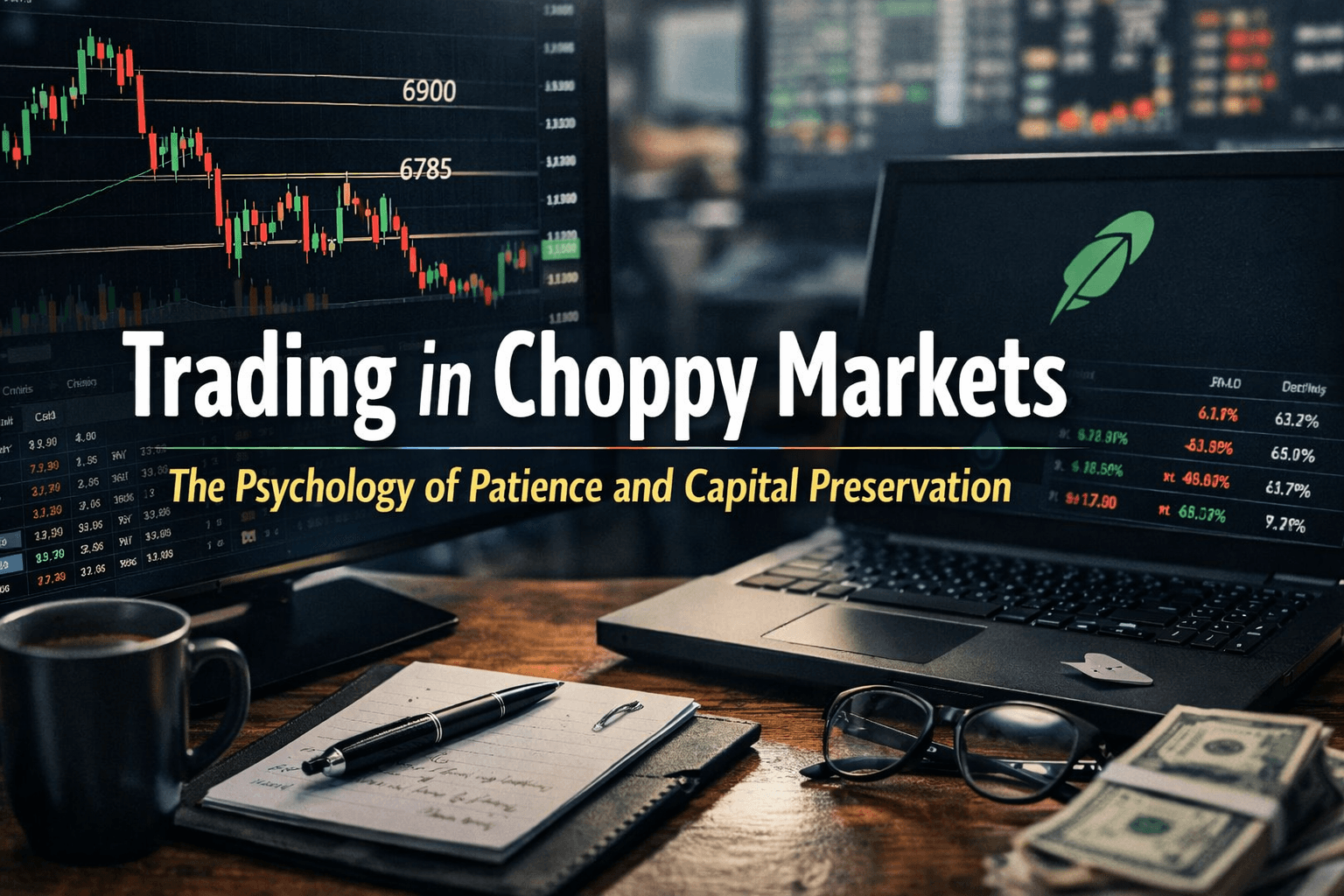
The more important technical levels were the Fibonacci zones around 6900 resistance and 6785 support.
Price initially rejected the 6900 Fibonacci resistance area, showing that buyers were not yet strong enough to sustain a breakout.
Later, futures rotated lower toward the 6785 Fibonacci support zone, where buyers stepped in and produced a sharp bounce.
Traders who chased the early breakdown would have been quickly trapped as the market reversed.
This type of price behavior has become increasingly common recently. The market repeatedly probes both sides of the range before reversing sharply.
These are classic signs of a market searching for direction but not yet ready to commit to one.
Understanding Mean Reversion
Another important concept in markets is that not every asset behaves the same way.
Some markets trend strongly, while others tend to revert back toward an average price over time.
A good example is the iShares MSCI Emerging Markets ETF (EEM).
Over the past fifteen years this ETF has largely traded within a long-term range rather than trending persistently higher like the S&P 500.
Traders who attempt to chase large breakout moves in EEM often get caught when price rotates back toward the middle of its historical range.
Understanding whether a market is trending or mean reverting can dramatically improve trade selection and risk management.
Our Approach at GAR Capital
At GAR Capital, we do not measure success by how many trades we send.
We measure success by the quality of the opportunities we provide to our clients.
When markets are trending and momentum is strong, those opportunities appear more frequently.
When markets are uncertain and dominated by reversals, discipline becomes more important than activity.
Our goal is not to force trades in difficult environments.
Our goal is to wait for the moments when the market provides clear setups with favorable risk and reward.
There will always be another opportunity.
Capital preservation today allows us to take advantage of better opportunities tomorrow.
Final Thoughts
Choppy markets test every trader’s patience. They reward discipline and punish impulsive decisions.
Right now the best edge we can have is patience.
We continue to monitor the market closely, track unusual options activity, and analyze developing setups.
When the right opportunity appears, we will act.
Until then, we remain focused on protecting capital and waiting for the market to provide clearer direction.
A Final Thought
“Patience is not the ability to wait.
Patience is the ability to keep a good attitude while waiting.”
Markets often test traders not with complexity, but with time.
The traders who survive the waiting are usually the ones who are ready when the real opportunity arrives.