

Summary
The VIX is often called the market’s fear gauge, but it’s better understood as the price of insurance on stocks. This article breaks down how to interpret VIX levels, what low and high readings signal about risk, sentiment, and volatility, and how investors can use the VIX as a context tool to manage risk, adjust exposure, and identify opportunity during periods of fear or complacency.
Economic Data
- 📈 Non-Farm Employment Change: Dec 16, 2025
- 📈 Retail Sales m/m: Dec 16, 2025
- 📈 CPI y/y: Dec 18, 2025
📚 Deep Dive 📚
📊 Understanding the VIX: The Market’s Price of Fear (and Opportunity)
One of the most misunderstood indicators in the market is the VIX, often referred to as the “fear gauge.” While that nickname isn’t wrong, it’s incomplete.
The best way to think about the VIX is much simpler:
The VIX is the cost of insurance on stocks.
More specifically, it represents the price of insuring the S&P 500 against volatility over the next 30 days.
🛡️ VIX = Insurance, Not Direction
When you insure your home or car, the premium rises when:
- Risk increases
- Claims become more likely
- Demand for insurance rises
The VIX works the same way:
- If investors expect turbulence, insurance demand rises → VIX goes up
- If markets are calm and confidence is high → VIX goes down
Important reminder:
- The VIX does not need to rise when stocks fall
- The VIX does not need to fall when stocks rise
Why? Because it’s a market — driven by supply and demand for protection — not a direct inverse of stock prices.
Also key: the VIX is forward-looking and based on a rolling 30-day window, so timeframe matters when interpreting it.
🧠 How We Personally Use the VIX
The VIX is not a stock, ETF, or commodity — it’s an index. That makes traditional technical analysis less reliable.
Instead, we use zones to understand risk appetite and market sentiment.
Below are the levels that matter most to us.
🟢 VIX Below 20: Risk Is On
20 is the line in the sand.
This level is somewhat arbitrary, but historically meaningful:
- Insurance demand is low
- Buyers of stocks are present
- Market participants are comfortable taking risk
- No immediate expectation of sharp downside
This is generally a constructive environment for equities.
⚠️ VIX Below 15: Complacency Warning
When the VIX drops below 15:
- Risk perception starts to fade
- Investors ignore future uncertainty
- Valuations can stretch
- Price discovery becomes thinner
This doesn’t mean “sell everything.”
It does mean:
Risk management matters more here.
🚨 VIX Below 12: Time to Take Chips Off the Table
When the VIX moves toward single digits:
- Complacency and greed dominate
- Markets price in perfection
- Nobody wants insurance — because nobody expects risk
This is not the time to aggressively add risk.
Historically, this zone signals a time to take profits on swing positions, rebalance, and reduce exposure — not panic sell, but respect the environment.
🔄 The Other Side: When Fear Takes Over
The VIX is just as valuable on the upside.
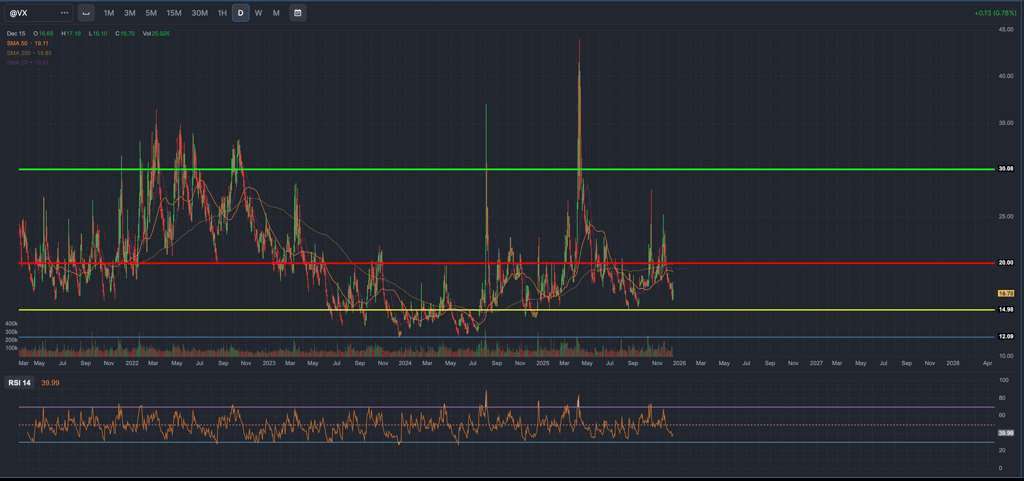
🔴 VIX Above 20: Pay Attention
- Risk perception rises
- Hedging activity increases
- Headlines often drive price action
Not outright panic — but this is where trends can change.
🔴 VIX Above 30: Fear Is Elevated
Over the past few years, VIX spikes above 30 have been rare:
- August 2024 – Fed concerns, jobs data, hard-landing fears, yen volatility
- April 2025 – Tariff-related panic
In both cases:
Stocks rebounded and went on to make new highs.
High fear often creates opportunity — after volatility stabilizes.
🔴 VIX Above 40: Extreme Fear
This has only happened a handful of times in recent history:
- COVID crash
- Tariff tantrum
These environments feel awful in real time — but historically, they have offered some of the best long-term buying opportunities.
🔴 VIX Above 50: Once-in-a-Lifetime Events
Only twice in nearly two decades:
- 2008 Financial Crisis
- 2020 COVID crash
These are true “Black Friday” moments in markets.
The hardest time to buy emotionally — and often the most rewarding over time.
🎯 The Big Takeaway
Buying stocks when the VIX is high isn’t easy.
Selling stocks when the VIX is extremely low isn’t easy either.
Pick your hard.
The VIX isn’t a trading signal — it’s a context tool.
- Low VIX = confidence and risk-on behavior
- High VIX = fear and risk-off behavior
Understanding that environment helps us:
- Adjust position size
- Manage expectations
- Avoid emotional decisions
- Identify opportunity when others can’t
We don’t trade the VIX — we listen to what it’s telling us about sentiment.
And sentiment, over time, drives markets.
TL;DR – How to Use the VIX
- The VIX is the price of insurance on stocks, not a direct predictor of market direction
- Low VIX = calm markets, high confidence, but rising complacency risk
- High VIX = fear, uncertainty, and often better long-term opportunity
- Below 15 → caution: tighten risk, take profits
- Below 12 → warning zone: expectations are too perfect, trim exposure
- Above 20 → manage risk more carefully
- Above 30–40 → fear spikes historically create buyable opportunity, not panic
- Use the VIX as a context tool, not a trade trigger